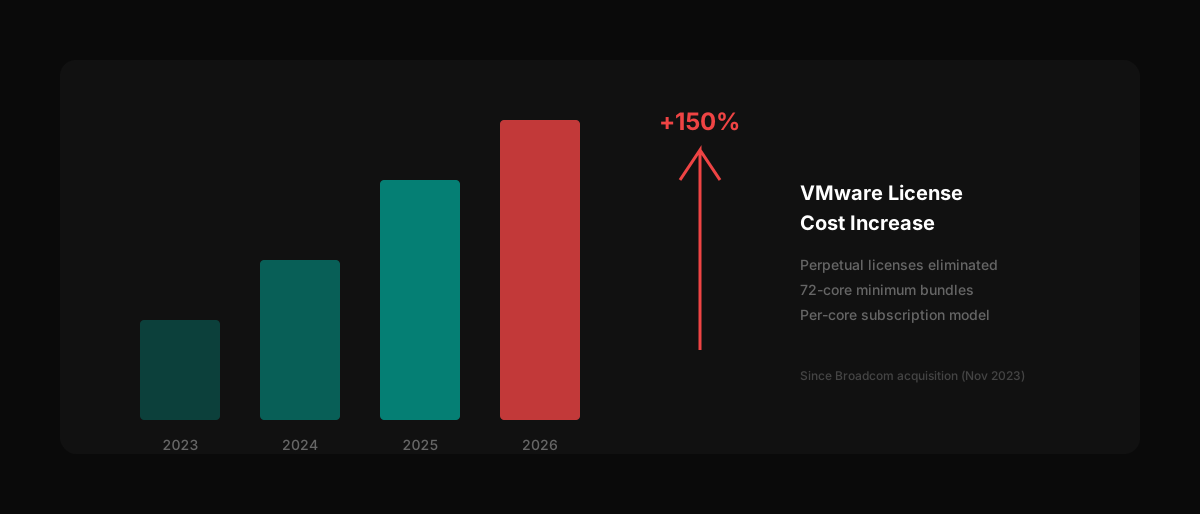
Broadcom's ownership of VMware has resulted in the most aggressive licensing restructuring in enterprise IT history. Since the November 2023 acquisition, perpetual licenses have been eliminated, product lines consolidated from 8,000+ SKUs to four bundles, and prices increased by 150–1,200% depending on environment size. This article documents every major change through March 2026, with specific pricing data and impact analysis for Czech enterprises.
What happened to VMware licensing after the Broadcom acquisition?
The Broadcom acquisition of VMware closed on November 22, 2023, for $61 billion. Within 90 days, Broadcom began restructuring VMware's entire commercial model. The changes were not gradual — they were abrupt, poorly communicated, and caught most customers off guard. Here is the complete timeline.
Timeline of Broadcom VMware licensing changes
| Date | Change | Impact |
|---|---|---|
| Nov 2023 | Broadcom completes VMware acquisition ($61B) | Ownership transfer; uncertainty begins |
| Dec 2023 | VMware partner program restructured | ~75% of channel partners dropped; Broadcom selects top-tier only |
| Feb 2024 | Perpetual licenses terminated | All customers forced to subscription model at renewal |
| Feb 2024 | Product SKUs consolidated | 8,000+ SKUs reduced to 4 bundles (VCF, VSF, VVF, VCF+) |
| Mar 2024 | Free ESXi eliminated | VMware vSphere Hypervisor (free) discontinued |
| Q2 2024 | First renewal shock | Customers report 200–1,200% price increases at renewal |
| Q3 2024 | Per-core licensing model introduced | Replaces per-socket model; 72-core minimum per CPU |
| Q4 2024 | vSphere Standard dropped from standalone sale | Only available within bundles |
| Q1 2025 | Broadcom reports VMware division revenue +24% | Price increases driving revenue, not new customers |
| H1 2025 | Additional bundle consolidation | Mid-tier options reduced; pressure toward VCF |
| Q1 2026 | Forced VCF migration for remaining vSphere customers | Customers pushed to VMware Cloud Foundation at renewal |
How did VMware pricing actually change?
The shift from per-socket perpetual licensing to per-core subscription fundamentally changes the cost equation. Under the old model, a 2-socket server with any number of cores cost one vSphere license. Under the new model, every core counts — with a 72-core minimum per CPU, regardless of actual core count.
Before vs. after: VMware licensing model comparison
| Aspect | Before (pre-2024) | After (2024–2026) |
|---|---|---|
| License type | Perpetual + annual SnS | Subscription only |
| Pricing unit | Per socket | Per core (72-core min/CPU) |
| Minimum commitment | 1 socket | 72 cores per CPU socket |
| Product availability | Individual products (vSphere, NSX, vSAN sold separately) | Bundles only (VCF, VSF) |
| Free tier | vSphere Hypervisor (free ESXi) | None |
| Contract term | 1–3 years (your choice) | 1–3 years (Broadcom preference: 3-year commit) |
| Partner support | 20,000+ partners globally | ~2,000 selected partners |
| Upgrade path | Upgrade individual products | Must upgrade entire bundle |
What does it actually cost in CZK?
Here is a concrete pricing comparison for three common Czech enterprise scenarios. Prices are based on publicly available list pricing and reported customer renewals as of Q1 2026.
Scenario 1: Small environment (10 servers, 2-socket, 16-core CPUs)
| Item | Old model (per-socket perpetual) | New model (per-core subscription/year) |
|---|---|---|
| License scope | 20 sockets | 20 CPUs x 72-core min = 1,440 cores billed |
| Actual cores | 320 cores | 320 cores (but billed for 1,440) |
| Annual cost (vSphere) | ~85,000 CZK (SnS only, license already owned) | ~360,000–480,000 CZK/year |
| Cost increase | — | +324–465% |
Scenario 2: Medium environment (50 servers, 2-socket, 32-core CPUs)
| Item | Old model | New model |
|---|---|---|
| License scope | 100 sockets | 100 CPUs x 72-core min = 7,200 cores billed |
| Actual cores | 3,200 cores | 3,200 cores (but billed for 7,200) |
| Annual cost (vSphere) | ~210,000 CZK (SnS renewal) | ~1,800,000–2,400,000 CZK/year |
| Cost increase | — | +757–1,043% |
Scenario 3: Large environment (100 servers, 2-socket, 64-core CPUs)
| Item | Old model | New model |
|---|---|---|
| License scope | 200 sockets | 200 CPUs x 72 cores = 14,400 cores billed |
| Actual cores | 12,800 cores | 12,800 cores (billed at actual since >72/CPU) |
| Annual cost (VSF bundle) | ~420,000 CZK (SnS renewal) | ~3,200,000–4,800,000 CZK/year |
| Cost increase | — | +662–1,043% |
The 72-core minimum is the critical factor. A server with 16-core CPUs pays for 72 cores per socket — 4.5x the actual core count. The penalty is inversely proportional to CPU density.
Why does the 72-core minimum matter so much?
The 72-core minimum per CPU socket is the single most impactful change in Broadcom's new licensing. It means every physical CPU is billed for at least 72 cores of licensing, regardless of the actual core count. For modern Intel Xeon or AMD EPYC processors, this creates dramatically different cost impacts depending on your hardware generation.
Impact by CPU generation
| CPU family | Typical core count | Cores billed (72-min) | Overpayment factor |
|---|---|---|---|
| Intel Xeon E5 v3/v4 (2015–2017) | 8–22 cores | 72 cores | 3.3–9.0x |
| Intel Xeon Gold 6xxx (2017–2021) | 16–36 cores | 72 cores | 2.0–4.5x |
| Intel Xeon Sapphire Rapids (2023+) | 32–60 cores | 72 cores | 1.2–2.3x |
| AMD EPYC 7003 (2021–2023) | 32–64 cores | 72 cores | 1.1–2.3x |
| AMD EPYC 9004 (2023+) | 64–128 cores | Actual count | 1.0x (but high core count = high cost) |
Organizations running older hardware — which is common in Czech enterprises with 5–7 year server refresh cycles — face the highest relative increase. A rack of Xeon E5 servers that cost 85,000 CZK/year in SnS now costs 360,000+ CZK/year in subscription licensing.
What happened to VMware's partner ecosystem in Czechia?
Broadcom's restructuring of the VMware partner program had a disproportionate impact on the Czech market. Before the acquisition, VMware had approximately 150 active partners in the Czech Republic. After Broadcom's partner rationalization, fewer than 20 remain authorized.
Impact on Czech customers:
- Reduced competition — Fewer partners means less competitive pricing and fewer options for support.
- Lost expertise — Many VMware-certified engineers at dropped partners have transitioned to alternative platforms (OpenStack, Proxmox, Nutanix).
- Longer sales cycles — Remaining partners are overloaded; license quotes that took 2 days now take 2–4 weeks.
- SME abandonment — Broadcom's focus on large enterprise accounts means Czech SMEs (under 500 employees) have difficulty getting attention or favorable terms.
What are the four VMware product bundles in 2026?
Broadcom consolidated VMware's extensive product catalog into four main bundles. Understanding these is essential for evaluating your renewal options.
VMware product bundles (2026)
| Bundle | Components | Target | Approx. CZK/core/year |
|---|---|---|---|
| VMware Cloud Foundation (VCF) | vSphere, vSAN, NSX, Aria | Large enterprise, full SDDC | 250–350 CZK |
| VMware vSphere Foundation (VSF) | vSphere, vCenter, Aria Ops | Standard virtualization + management | 180–250 CZK |
| VMware vSphere Standard | vSphere, vCenter (basic) | Entry-level (limited availability) | 130–180 CZK |
| VMware vSphere Essentials Plus | vSphere for 3 hosts max | Small business | ~90,000 CZK/year (flat) |
Key issue: you cannot buy individual products. If you need NSX networking, you must purchase VCF — the most expensive bundle — even if you don't need vSAN or Aria. This forced bundling increases costs by 30–80% for customers who previously bought only the components they needed.
How does this affect Czech enterprise IT budgets?
Czech enterprises typically allocate 15–25% of their IT budget to infrastructure licensing. The VMware price increases push virtualization licensing from a manageable line item to a strategic budget concern. Based on Pro-zeta's analysis of 40+ Czech enterprise environments assessed in 2025:
- Average VMware cost increase at renewal: 212% (median across all assessed environments)
- Highest increase observed: 1,180% (SME customer, 15 servers, older hardware)
- Budget impact: VMware licensing moved from 8% to 22% of total IT infrastructure spend on average
- Contract pressure: Broadcom offers 10–15% discount for 3-year commitments, creating lock-in pressure
Real-world example: Czech financial services company
- Environment: 80 servers, 2-socket, Intel Xeon Gold 6248 (20 cores)
- Previous annual cost: 168,000 CZK (perpetual license SnS)
- New annual cost (VSF): 576,000 CZK/year (160 CPUs x 72-core min = 11,520 cores billed)
- Increase: 243%
- Action taken: Migrated 60 servers to Pro-zeta Tier5 OpenStack, kept 20 on VMware for legacy apps
- New annual cost: ~290,000 CZK/year (VMware reduced + Tier5 subscription)
- Net savings: 286,000 CZK/year (vs. full VMware renewal)
What alternatives exist to VMware in 2026?
The VMware alternative market has matured rapidly since 2024. Organizations now have credible options across the full spectrum of virtualization and cloud needs.
VMware alternatives comparison
| Platform | License cost | Best for | Limitations |
|---|---|---|---|
| Proxmox VE | 0 CZK (open source) | SME, simple virtualization | Limited multi-tenancy, no enterprise SDN |
| OpenStack (self-managed) | 0 CZK (open source) | Large orgs with Linux expertise | Complex to operate, requires dedicated team |
| OpenStack managed (Pro-zeta Tier5) | Subscription | Enterprise private cloud | Requires committed capacity |
| Nutanix | Commercial license | HCI-focused environments | Expensive, another proprietary vendor |
| Microsoft Hyper-V | Included with Windows Server | Windows-heavy shops | Feature-limited vs. vSphere, uncertain future |
| Red Hat OpenShift Virtualization | Subscription | Kubernetes-first orgs | Relatively new for traditional VM workloads |
Decision framework
- Under 30 VMs, simple workloads → Proxmox VE (zero license cost)
- 30–200 VMs, need API/multi-tenant → Managed OpenStack (Pro-zeta Tier5)
- 200+ VMs, regulated industry → Managed OpenStack with ISO 27001 compliance
- Kubernetes-native → OpenShift Virtualization or bare-metal K8s
- Temporary bridge → Negotiate VMware short-term renewal while planning migration
Pro-zeta has been helping Czech enterprises exit VMware since 2024. Whether you need Proxmox for straightforward virtualization, Tier5 OpenStack for enterprise cloud, or a hybrid approach, our engineers provide assessment, migration, and ongoing managed services.
How should you negotiate your VMware renewal?
If you must stay on VMware temporarily, there are tactics to minimize cost impact. Broadcom's sales teams have quotas and flexibility — especially for larger deals and multi-year commits.
Negotiation strategies:
- Get competitive quotes first — Have a concrete Proxmox or OpenStack migration proposal before negotiating. Broadcom responds to credible alternatives.
- Challenge the 72-core minimum — In some cases, especially for customers with 10,000+ cores, Broadcom has offered actual-core billing. Always ask.
- Avoid 3-year lock-in — The 10–15% discount for 3-year terms is not worth it if you plan to migrate within 18 months.
- Unbundle what you can — If you only need vSphere, push back on VCF. VSF or vSphere Standard may still be available for existing customers.
- Document everything — Save all correspondence. Broadcom's pricing changes have drawn regulatory attention in the EU, and documented price increases may support future claims.
What is the regulatory outlook for VMware licensing in Europe?
EU competition authorities have begun examining Broadcom's VMware licensing practices. In 2025, the European Commission received formal complaints from multiple European enterprise groups regarding forced bundling and excessive price increases. While no formal investigation has been announced as of March 2026, the regulatory environment is shifting.
Key developments:
- EU Digital Markets Act — May apply to VMware as a "core platform service" if market share thresholds are met.
- German Federal Cartel Office — Initiated preliminary review of VMware licensing complaints in Q3 2025.
- CISPE (Cloud Infrastructure Services Providers in Europe) — Filed formal complaint regarding VMware licensing impact on European cloud providers.
These developments may create leverage for customers in renewal negotiations, but should not be relied upon for short-term cost relief.
What should you do right now?
Regardless of your current VMware contract status, take these steps immediately.
- Audit your VMware estate — Document every socket, core, and license. Know exactly what you are paying for today.
- Calculate your renewal cost — Use Broadcom's per-core model to estimate your next renewal. The VMware price increase impact page has a calculator.
- Assess alternatives — Contact Pro-zeta for a free VMware environment assessment. We analyze your workloads and recommend the optimal migration path.
- Plan your timeline — Align migration with your VMware contract renewal date. Starting 6–9 months before renewal gives adequate time.
- Budget for migration — Migration costs 200,000–400,000 CZK for a 100-server environment. This is a one-time cost vs. ongoing annual VMware increases.
Every month you delay costs money. VMware licensing only gets more expensive — Broadcom has stated publicly that they intend to continue optimizing VMware's revenue per customer. The time to act is now.
Contact Pro-zeta at info@prozeta.eu or visit our VMware alternative page to start your assessment.