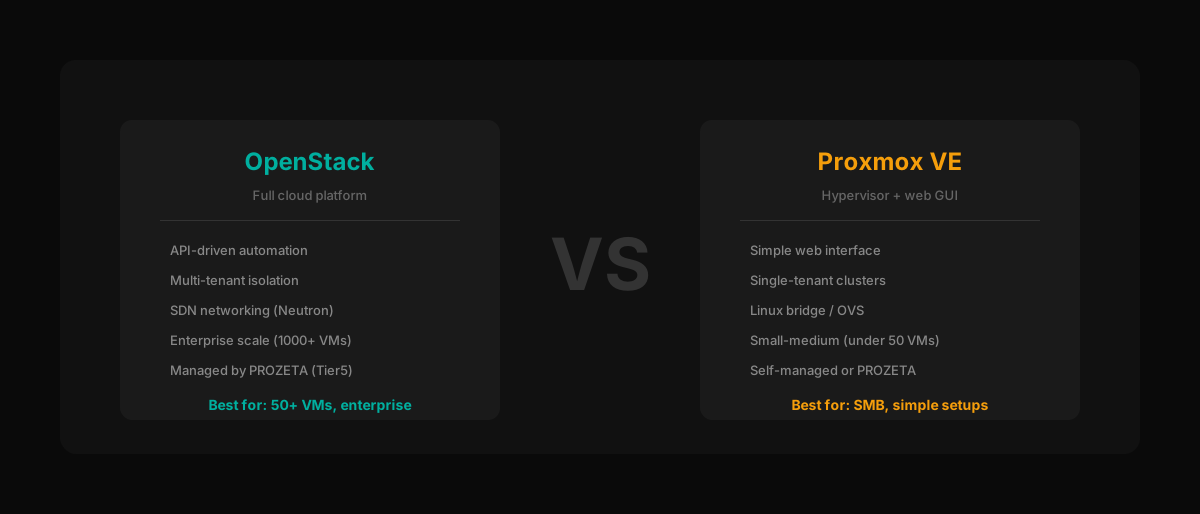
What is the fundamental difference between OpenStack and Proxmox?
OpenStack is a full cloud operating system — a modular platform of 30+ services (compute, networking, storage, identity, orchestration) that turns bare-metal servers into a self-service cloud with API-driven automation. Proxmox VE is a hypervisor management layer built on KVM and LXC that provides a web GUI for creating and managing virtual machines. Both are open source. Both replace VMware. But they solve different problems at different scales.
Understanding this distinction is critical for CTOs evaluating a VMware alternative. Choosing the wrong platform costs time, money, and operational flexibility. This article provides a data-driven comparison based on Pro-zeta's 8+ years of operating OpenStack in production and our growing Proxmox practice.
How do OpenStack and Proxmox differ in architecture?
OpenStack is a distributed system composed of independent microservices communicating via message queues and REST APIs. Each service (Nova for compute, Neutron for networking, Cinder for block storage, Keystone for identity) can be scaled and updated independently. A production OpenStack deployment typically requires 3+ controller nodes, dedicated networking nodes, and multiple compute nodes — minimum 6-8 servers for a resilient setup.
Proxmox VE is a monolithic appliance. You install it on a server, open the web UI, and start creating VMs. A single node works. A 3-node cluster provides HA. There is no separate networking service, no identity service, no orchestration layer — it is an integrated hypervisor with a management interface.
Key architectural differences:
- API surface: OpenStack exposes 100+ API endpoints across services. Proxmox has a single REST API with limited scope.
- Multi-tenancy: OpenStack has native projects, quotas, RBAC, and network isolation per tenant. Proxmox has basic user permissions — no tenant isolation.
- Service catalog: OpenStack includes object storage (Swift), DNS (Designate), load balancing (Octavia), container orchestration (Magnum). Proxmox offers VMs and containers.
- Deployment complexity: OpenStack requires Ansible/Kolla/TripleO deployment tools and Linux expertise. Proxmox installs from ISO in 15 minutes.
When should you choose Proxmox over OpenStack?
Proxmox is the right choice when simplicity outweighs scalability. For organizations running fewer than 50 VMs on 3-5 physical hosts with a small IT team (1-3 people), Proxmox delivers excellent value with minimal operational overhead. It is a direct VMware vSphere replacement — same mental model, similar GUI, fraction of the cost.
Proxmox is ideal for:
- Small and medium businesses with <50 VMs
- Development and testing environments
- Single-site deployments without multi-tenancy needs
- Teams familiar with VMware vSphere who want a similar workflow
- Budget-constrained projects where 0 CZK licensing is critical
- Edge computing or branch office infrastructure
Concrete scenario: A company with 3 HPE ProLiant servers, 20 VMs, and 2 IT admins. Proxmox installs in under an hour, provides live migration, ZFS snapshots, and a clean web interface. Total software cost: 0 CZK (Community) or ~50,000 CZK/year for Proxmox subscription per 3 nodes.
Pro-zeta offers managed Proxmox services for organizations that want enterprise support without the VMware price tag.
When does OpenStack become the better choice?
OpenStack becomes necessary when your infrastructure requirements exceed what a hypervisor alone can provide. If you need API-driven provisioning, multi-tenant isolation, software-defined networking, or integration with Kubernetes and CI/CD pipelines, OpenStack is the only open-source platform that delivers all of these natively.
OpenStack is essential for:
- Organizations running 50+ VMs with growth plans
- Multi-tenant environments (ISPs, MSPs, SaaS providers)
- API-first infrastructure (DevOps, IaC with Terraform/Ansible)
- Hybrid cloud architectures connecting on-prem with public cloud
- Regulated industries requiring network microsegmentation and audit trails
- Kubernetes platforms needing integrated networking and storage
Concrete scenario: A SaaS company with 200+ VMs across 15 compute nodes, 3 development teams each needing isolated environments, CI/CD pipelines provisioning test infrastructure via API, and compliance requirements for network isolation. OpenStack handles this natively. Proxmox would require extensive manual configuration and scripting with no guarantees of tenant isolation.
Pro-zeta's Tier5 managed OpenStack delivers this capability without requiring your team to become OpenStack specialists.
How do the features compare side by side?
| Feature | OpenStack | Proxmox VE |
|---|---|---|
| Hypervisor | KVM (via Nova) | KVM + LXC |
| API | Full REST API (100+ endpoints) | Single REST API (limited scope) |
| Web dashboard | Horizon (extensible) | Built-in GUI (polished) |
| Networking (SDN) | Neutron + OVN — full SDN with VXLAN, security groups, floating IPs, LBaaS, VPN | Basic Linux bridge/OVS, SDN zone plugin (limited) |
| Block storage | Cinder — pluggable backends (Ceph, BlackStor, LVM, NetApp) | ZFS, Ceph, LVM, iSCSI |
| Object storage | Swift (native) or RadosGW | None |
| Identity/auth | Keystone — LDAP, SAML, OIDC, MFA, projects, domains | PAM, LDAP, basic RBAC |
| Multi-tenancy | Native: projects, quotas, network isolation, RBAC | None — shared resource pool |
| High availability | Masakari (auto-evacuate), clustered services | HA cluster (auto-restart on node failure) |
| Live migration | Yes (Nova live-migration) | Yes |
| Scaling | Linear — add compute/storage nodes independently | Cluster scaling (max ~32 nodes practical) |
| Orchestration | Heat templates, Magnum (K8s), Senlin (auto-scaling) | None |
| Backup | Project-level, integrated with storage backend | Proxmox Backup Server (excellent) |
| Terraform provider | Official, mature | Community, functional |
| Kubernetes integration | Magnum, Cluster API, native LBaaS | Manual setup |
| Min. deployment size | 6-8 servers (production HA) | 1 server (standalone) |
| Setup time | Days to weeks | 15 minutes to 1 hour |
| Operational complexity | High (mitigated by managed service) | Low to medium |
| License cost | 0 CZK | 0 CZK (Community) / ~17,000 CZK/node/year (subscription) |
What about storage — Ceph, ZFS, or BlackStor?
Storage is often the deciding factor in infrastructure platform selection. Proxmox excels with ZFS integration — snapshots, compression, deduplication, and send/receive replication are built in. For small deployments (3-5 nodes), ZFS on local disks provides excellent performance without additional infrastructure.
OpenStack's Cinder provides a pluggable storage framework. Most OpenStack deployments use Ceph as the storage backend — it is open source, scalable, and well-integrated. However, Ceph requires minimum 3 dedicated storage nodes, adds significant operational complexity, and delivers inconsistent latency under mixed workloads.
Pro-zeta uses BlackStor — not Ceph. BlackStor is Pro-zeta's proprietary storage platform optimized for OpenStack workloads. Compared to Ceph:
- 30-50% lower latency on random 4K IOPS
- Deterministic performance — no noisy-neighbor effects
- Simpler operations — single management interface, no CRUSH map tuning
- Integrated backup — snapshot and replication built in
This is a key differentiator of Pro-zeta's Tier5 cloud — you get OpenStack's API and multi-tenancy with storage performance that beats typical Ceph deployments.
How do the costs compare in practice?
Both platforms are open source, so the software itself is free. The real costs are in hardware, operations, and expertise.
Proxmox costs (3-node cluster, ~30 VMs)
- Hardware: 3 servers (HPE DL360, 2x CPU, 512 GB RAM, NVMe) — ~1,500,000 CZK one-time
- Proxmox subscription: ~50,000 CZK/year (Standard, 3 nodes)
- Staff: 0.5 FTE sysadmin — ~450,000 CZK/year
- Power/cooling: ~120,000 CZK/year
- Total annual (after HW): ~620,000 CZK/year
OpenStack costs — DIY (10-node cluster, ~150 VMs)
- Hardware: 10 servers + 3 storage nodes — ~6,500,000 CZK one-time
- OpenStack license: 0 CZK
- Staff: 2-3 FTE OpenStack engineers — 2,400,000-4,500,000 CZK/year
- Power/cooling: ~400,000 CZK/year
- Total annual (after HW): ~3,200,000-5,300,000 CZK/year
OpenStack costs — Managed (Pro-zeta Tier5, ~150 VMs)
- Hardware: Included or customer-owned
- Managed platform fee: ~1,200,000-1,800,000 CZK/year
- Staff: 0 dedicated OpenStack FTE needed
- Power/cooling: Included (Pro-zeta DC) or ~400,000 CZK (on-prem)
- Total annual: ~1,200,000-2,200,000 CZK/year
Key insight: DIY OpenStack is expensive because OpenStack engineers command 80,000-120,000 EUR/year salaries in Central Europe (2,000,000-3,000,000 CZK). Managed OpenStack eliminates this cost while delivering the same — or better — platform quality.
Can you migrate from Proxmox to OpenStack later?
Yes, and this is a viable growth path. Many organizations start with Proxmox for its simplicity, then migrate to OpenStack when they outgrow Proxmox's capabilities. The migration is straightforward because both use KVM — the underlying disk images (qcow2, raw) are compatible.
Typical migration path:
- Start with Proxmox (3-5 nodes, <50 VMs)
- Grow to 50+ VMs, need multi-tenancy or API automation
- Deploy OpenStack alongside Proxmox (parallel operation)
- Migrate VMs via image export/import (qcow2 compatible)
- Decommission Proxmox cluster
Pro-zeta supports both platforms and can assist with this transition. The shared KVM base means no VM conversion is needed — unlike migrating from VMware, which requires VMDK-to-qcow2 conversion.
What are the operational differences day-to-day?
Day-to-day operations differ significantly between the two platforms. Proxmox operations resemble traditional VMware administration — you log into the web GUI, right-click to create VMs, monitor resource usage, and manage storage. One senior sysadmin can comfortably manage a 5-node Proxmox cluster alongside other responsibilities.
OpenStack operations are more complex. Updates require coordinated service upgrades across multiple nodes. Troubleshooting involves log analysis across 10+ services. Capacity planning requires understanding service-specific resource requirements. A 10-node OpenStack cluster typically demands 1-2 dedicated engineers — or a managed service agreement.
Operational comparison:
- Upgrades: Proxmox — apt upgrade + reboot per node. OpenStack — rolling service upgrades, database migrations, API compatibility checks.
- Monitoring: Proxmox — built-in dashboard sufficient. OpenStack — requires Prometheus/Grafana, log aggregation (ELK), service health checks.
- Troubleshooting: Proxmox — systemctl, journalctl, web GUI. OpenStack — service logs across 10+ components, message queue inspection, database queries.
- Backup: Proxmox — Proxmox Backup Server (excellent, integrated). OpenStack — depends on storage backend and configuration.
Which platform should you choose as a VMware alternative?
The decision comes down to scale, complexity, and team capabilities. Here is a simplified decision framework:
Choose Proxmox if: - You run <50 VMs on <5 hosts - Your team is 1-3 people - You need a simple, VMware-like experience - Multi-tenancy is not required - Budget is the primary driver
Choose OpenStack if: - You run 50+ VMs with growth plans - You need API-driven infrastructure (DevOps/IaC) - Multi-tenancy or network isolation is required - You plan to integrate Kubernetes at scale - You want a cloud platform, not just a hypervisor
Choose managed OpenStack (Pro-zeta Tier5) if: - You need OpenStack capabilities without OpenStack complexity - You want predictable OpEx instead of unpredictable staff costs - You require 24/7 SLA and expert support - You value performance (BlackStor > Ceph)
Both platforms are legitimate VMware alternatives. Proxmox replaces VMware vSphere. OpenStack replaces the entire VMware Cloud Foundation stack. Pro-zeta operates both — Proxmox for smaller deployments and Tier5 OpenStack for enterprise scale — and can help you choose the right platform for your specific requirements.
Frequently asked questions
Is Proxmox production-ready for enterprise use?
Yes. Proxmox VE 8.x is used in production by thousands of organizations. It has been in development since 2008 (18 years). The subscription model provides enterprise support, and the underlying KVM/QEMU/LXC stack is battle-tested in the Linux kernel. However, it lacks enterprise features like native multi-tenancy and comprehensive API automation.
Can OpenStack and Proxmox run on the same hardware?
Not simultaneously on the same nodes. They manage hardware resources differently. However, you can run them in the same datacenter on separate server groups and connect them via shared networks. Some organizations use Proxmox for legacy workloads and OpenStack for new cloud-native applications.
Which is better for Kubernetes?
OpenStack. It provides Magnum for managed Kubernetes clusters, Octavia for load balancing, Cinder for persistent volumes, and Neutron for pod networking — all via API. Proxmox can host Kubernetes VMs, but you must configure networking, storage, and load balancing manually.
Does Pro-zeta support both platforms?
Yes. Pro-zeta offers managed Proxmox for smaller deployments and Tier5 managed OpenStack for enterprise-scale infrastructure. Both run on HPE hardware in Pro-zeta's ISO 27001-certified datacenter in Prague.
How long does migration from VMware take?
For Proxmox: 1-2 weeks for a typical 20-30 VM environment. For OpenStack: 4-8 weeks for a 100+ VM enterprise environment. Both involve VMDK-to-qcow2 conversion, network reconfiguration, and validation testing. Pro-zeta provides migration services for both platforms.