How much does OpenStack actually cost to run?
The software is free. The infrastructure is not. A production OpenStack deployment for 150 VMs costs between 1,200,000 and 5,300,000 CZK per year depending on whether you self-manage or use a managed service. The largest cost component is not hardware or power — it is people. OpenStack engineers command 80,000-120,000 EUR/year (2,000,000-3,000,000 CZK) in Central Europe, and you need 2-3 of them for a production environment.
This article breaks down every cost component of running OpenStack in 2026, compares DIY vs managed vs VMware vs public cloud, and explains why managed OpenStack from providers like Pro-zeta Tier5 is often the most cost-effective path to enterprise cloud infrastructure.
What are the hardware costs for OpenStack?
Hardware is the foundational capital expense. A production OpenStack deployment requires controller nodes, compute nodes, storage nodes, and network infrastructure. The exact configuration depends on workload requirements, but here is a reference architecture for a mid-size deployment (100-200 VMs).
Reference architecture — 150 VM capacity:
| Component | Specification | Quantity | Unit cost (CZK) | Total (CZK) |
|---|---|---|---|---|
| Controller nodes | HPE DL360 Gen11, 2x Xeon Gold, 256 GB RAM, 2x 960 GB NVMe | 3 | 350,000 | 1,050,000 |
| Compute nodes | HPE DL360 Gen11, 2x Xeon Gold, 512 GB RAM, 2x 1.92 TB NVMe | 8 | 550,000 | 4,400,000 |
| Storage nodes | HPE DL380 Gen11, 2x Xeon Silver, 128 GB RAM, 12x 3.84 TB NVMe | 3 | 900,000 | 2,700,000 |
| ToR switches | 25/100 GbE, 48-port | 2 | 250,000 | 500,000 |
| Spine switch | 100 GbE | 1 | 400,000 | 400,000 |
| UPS + PDU | Rack-level | 2 | 150,000 | 300,000 |
| Total hardware | 9,350,000 |
Hardware amortization: Over 5 years (standard server lifecycle), this is 1,870,000 CZK/year. Over 7 years (extended with warranty), 1,335,000 CZK/year.
Key considerations:
- Enterprise hardware (HPE, Dell, Lenovo) costs 30-50% more than white-box but provides warranty, firmware updates, and hardware monitoring.
- NVMe storage is now cost-effective enough that spinning disks are only justified for cold storage or archival workloads.
- 25 GbE networking is the minimum for production. 100 GbE is recommended for storage traffic.
What does OpenStack staffing cost?
Staffing is the dominant cost and the most variable. OpenStack is a complex distributed system. Running it in production requires deep Linux, networking, and OpenStack-specific expertise. These skills are scarce and expensive.
OpenStack engineer salaries in Central Europe (2026):
| Role | Annual salary (CZK) | Annual salary (EUR) |
|---|---|---|
| Junior OpenStack engineer | 1,200,000-1,600,000 | 48,000-64,000 |
| Senior OpenStack engineer | 1,800,000-2,500,000 | 72,000-100,000 |
| OpenStack architect | 2,500,000-3,000,000 | 100,000-120,000 |
Staffing requirements by deployment size:
| Deployment size | VMs | Staff requirement | Annual cost (CZK) |
|---|---|---|---|
| Small (3-5 compute nodes) | 30-50 | 1 FTE + part-time backup | 1,500,000-2,000,000 |
| Medium (8-15 compute nodes) | 100-200 | 2 FTE | 3,600,000-5,000,000 |
| Large (20+ compute nodes) | 300+ | 3-4 FTE | 5,400,000-10,000,000 |
The staffing trap: Many organizations underestimate staffing costs. They budget for 1 engineer, discover that person cannot cover on-call, vacations, and project work simultaneously, then scramble to hire a second — at a premium, because OpenStack talent is scarce.
What OpenStack staff actually do:
- Day-to-day operations: monitoring, incident response, capacity planning
- Upgrades: OpenStack releases every 6 months; skipping releases creates technical debt
- Security patching: Linux kernel, OpenStack services, dependencies
- Hardware lifecycle: disk replacements, firmware updates, node additions
- Tenant support: network configuration, quota adjustments, troubleshooting
What are the ongoing operational costs?
Beyond hardware and staff, several recurring costs are often overlooked in initial planning.
Annual operational costs (150 VM deployment):
| Cost category | Annual cost (CZK) | Notes |
|---|---|---|
| Power + cooling | 350,000-500,000 | ~15 kW average draw at 3-4 CZK/kWh |
| Colocation | 300,000-600,000 | 2-3 racks in a Tier III DC |
| Internet transit | 120,000-240,000 | 1 Gbps committed + burstable |
| Hardware warranty ext. | 200,000-350,000 | After initial 3-year warranty expires |
| Monitoring/tooling | 50,000-120,000 | Prometheus, Grafana, ELK licenses or hosting |
| Backup storage | 100,000-250,000 | Off-site backup for disaster recovery |
| Training/conferences | 50,000-100,000 | Keeping team skills current |
| Total operational | 1,170,000-2,160,000 |
Power calculation detail: A 14-server deployment draws approximately 12-18 kW. At Czech industrial electricity rates of 3-4 CZK/kWh (2026 pricing), that is 315,000-630,000 CZK/year. Add cooling overhead (PUE 1.3-1.5 in a modern DC) and the total energy cost is 400,000-950,000 CZK/year.
How does DIY OpenStack compare to managed OpenStack?
The difference between self-managed and managed OpenStack is primarily about staffing costs and operational risk. A managed provider like Pro-zeta absorbs the complexity and delivers a predictable monthly cost.
| Cost component | DIY OpenStack | Managed (Pro-zeta Tier5) |
|---|---|---|
| Hardware | 9,350,000 (customer owns) | Included or customer-owned |
| OpenStack license | 0 CZK | 0 CZK |
| Staff (OpenStack ops) | 3,600,000-5,000,000/year | 0 CZK (Pro-zeta staff) |
| Platform management fee | 0 CZK | 1,200,000-1,800,000/year |
| Power/cooling | 350,000-500,000/year | Included (Pro-zeta DC) |
| Colocation | 300,000-600,000/year | Included (Pro-zeta DC) |
| Monitoring tooling | 50,000-120,000/year | Included |
| 24/7 support | Internal (staff cost) | Included |
| SLA | Internal target | Contractual (99.99%+) |
| Backup (BlackStor) | Additional cost | Included |
| Year 1 total | 13,650,000-15,570,000 | 1,200,000-1,800,000 |
| Year 2-5 annual | 4,300,000-6,420,000 | 1,200,000-1,800,000 |
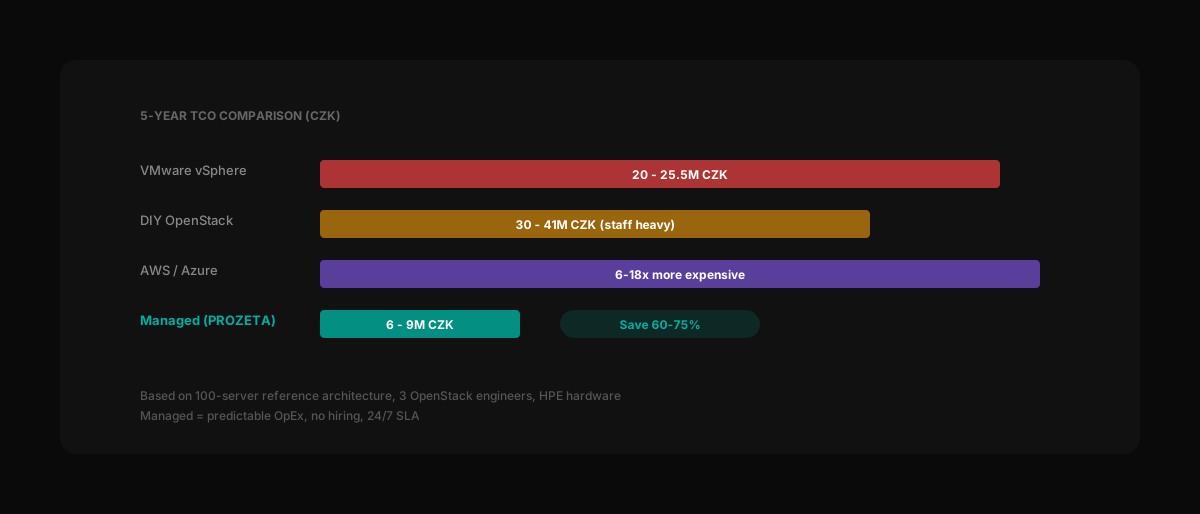
| 5-year TCO | 30,850,000-41,250,000 | 6,000,000-9,000,000 |
5-year savings with managed OpenStack: 60-75%. The math is straightforward — you trade 2-3 expensive engineer salaries for a managed service fee that is a fraction of the cost.
What managed OpenStack from Pro-zeta Tier5 includes:
- Full OpenStack platform deployment and lifecycle management
- 24/7 monitoring and incident response
- Quarterly OpenStack upgrades (no version skipping)
- BlackStor storage (30-50% lower latency than Ceph)
- HPE enterprise hardware with proactive replacement
- ISO 27001 + ISO 9001 certified datacenter in Prague
- No noisy neighbors — dedicated compute, not shared
How does OpenStack compare to VMware on cost?
VMware has become significantly more expensive since Broadcom's acquisition. The forced bundling of VCF (VMware Cloud Foundation) and elimination of perpetual licenses means most organizations now pay 2-3x what they paid before 2024.
3-year TCO comparison — 150 VM environment:
| Cost component | VMware VCF | DIY OpenStack | Managed OpenStack (Pro-zeta) |
|---|---|---|---|
| Software/license | 4,500,000-6,000,000 | 0 | 0 |
| Hardware | 9,000,000 | 9,350,000 | Included |
| Staff | 3,000,000-4,500,000 | 10,800,000-15,000,000 | 0 |
| Managed fee | 0 | 0 | 3,600,000-5,400,000 |
| Operations | 3,500,000-6,000,000 | 3,510,000-6,480,000 | Included |
| 3-year TCO | 20,000,000-25,500,000 | 23,660,000-30,830,000 | 3,600,000-5,400,000 |
| Per VM/month | ~3,700-4,700 CZK | ~4,400-5,700 CZK | ~670-1,000 CZK |
Key observations:
- VMware and DIY OpenStack have similar 3-year TCO — VMware's license cost roughly equals OpenStack's staffing premium.
- Managed OpenStack is 4-5x cheaper than both because it eliminates the two largest costs: licenses (vs VMware) and specialized staff (vs DIY OpenStack).
- VMware costs are escalating year over year. OpenStack costs are stable or declining (hardware gets cheaper, automation improves).
How does OpenStack compare to public cloud costs?
Public cloud (AWS, Azure, GCP) is the obvious alternative. It requires zero CapEx and scales instantly. But for predictable, steady-state workloads, it is significantly more expensive than on-premises or managed private cloud.
Monthly cost comparison — equivalent workload (150 VMs, 600 vCPU, 2.4 TB RAM, 50 TB storage):
| Provider | Monthly cost (CZK) | Annual cost (CZK) | 3-year cost (CZK) |
|---|---|---|---|
| AWS EC2 (on-demand) | 1,800,000 | 21,600,000 | 64,800,000 |
| AWS EC2 (reserved 3yr) | 900,000 | 10,800,000 | 32,400,000 |
| Azure VMs (PAYG) | 1,650,000 | 19,800,000 | 59,400,000 |
| Azure VMs (reserved 3yr) | 825,000 | 9,900,000 | 29,700,000 |
| Managed OpenStack (Pro-zeta) | 100,000-150,000 | 1,200,000-1,800,000 | 3,600,000-5,400,000 |
Public cloud costs 6-18x more than managed OpenStack for equivalent steady-state workloads. Public cloud makes sense for variable workloads, global distribution, or when you lack datacenter presence. For predictable European workloads, private cloud wins on cost.
Hidden public cloud costs not in the table:
- Data egress: AWS charges 2.10 CZK/GB for data leaving the region. 10 TB/month = 21,000 CZK/month.
- Storage IOPS: High-performance storage (io2) costs 3-5x more than gp3 baseline.
- Support: AWS Business Support is 10% of monthly spend. Enterprise Support starts at 375,000 CZK/month.
- Networking: NAT Gateway, VPN, Transit Gateway — each adds cost.
- Compliance: Data residency in Czech Republic is not guaranteed without specific configuration.
What are the hidden costs most organizations miss?
After consulting with hundreds of organizations on cloud infrastructure decisions, Pro-zeta has identified the most commonly overlooked cost categories.
How much does OpenStack expertise cost to acquire?
Training an existing Linux admin to become proficient in OpenStack takes 6-12 months of focused work. During that time, productivity on other tasks drops. The hidden cost is opportunity cost — what else could that person be doing?
- Formal training: Red Hat OpenStack courses — 80,000-120,000 CZK per person
- Certification: Red Hat RHCA in Cloud — 200,000+ CZK (multiple exams + training)
- Ramp-up time: 6-12 months to production competence
- Retention risk: Once trained, OpenStack engineers are in high demand and may leave
What about upgrade and migration costs?
OpenStack releases new versions every 6 months. Each upgrade requires testing, planning, and execution. Skipping versions creates technical debt and security risk.
- Major upgrade (e.g., Zed to 2024.1): 2-4 weeks of engineering time per upgrade
- Skip-level upgrades: Not officially supported; requires intermediate upgrades
- Annual upgrade cost (staff time): 300,000-600,000 CZK
How do you account for downtime risk?
Self-managed OpenStack without proper HA and expertise carries higher downtime risk.
- Cost of 1 hour downtime (mid-size company): 50,000-500,000 CZK (depending on business impact)
- Average incidents per year (self-managed without SLA): 3-8 unplanned outages
- Average incident duration: 2-8 hours
With a managed provider like Pro-zeta, contractual SLAs (99.99%+) shift this risk to the provider.
What is the most cost-effective path to OpenStack in 2026?
For most organizations in the Czech Republic and Central Europe, managed OpenStack is the most cost-effective approach. The math is clear: managed service fees (1,200,000-1,800,000 CZK/year) are a fraction of DIY staffing costs (3,600,000-5,000,000 CZK/year) — and you get better SLAs, faster upgrades, and premium storage (BlackStor) included.
Decision framework by budget:
| Annual infrastructure budget | Recommended approach |
|---|---|
| < 500,000 CZK | Public cloud or Proxmox (not OpenStack) |
| 500,000-1,500,000 CZK | Managed OpenStack (Pro-zeta Tier5) |
| 1,500,000-5,000,000 CZK | Managed OpenStack with dedicated hardware |
| > 5,000,000 CZK | Evaluate DIY vs managed based on team capabilities |
Why Pro-zeta Tier5 specifically?
- 8+ years of OpenStack production experience (since 2016)
- BlackStor storage — 30-50% lower latency than Ceph, no noisy neighbors
- HPE hardware — enterprise-grade with proactive replacement
- Prague datacenter — ISO 27001 + ISO 9001, Czech data residency
- Predictable pricing — fixed monthly OpEx, no surprises
- References: Alma Career, Fortuna, Sazka, PK62 IPTV
Ready to get a cost estimate for your specific workload? Contact Pro-zeta for a no-obligation TCO analysis comparing your current VMware or public cloud costs with managed OpenStack.
If you are evaluating OpenStack as a VMware alternative, the cost advantage is substantial — especially when combined with a managed service that eliminates the staffing premium.
Frequently asked questions
Is OpenStack really free?
The software is free (Apache 2.0 license). There are no per-core, per-VM, or per-socket fees. But running OpenStack requires hardware, networking, power, cooling, and skilled engineers. The total cost of ownership depends on your deployment model (DIY vs managed).
How much cheaper is OpenStack than VMware?
For a 150-VM environment over 3 years: managed OpenStack costs 3,600,000-5,400,000 CZK vs VMware VCF at 20,000,000-25,500,000 CZK. That is a 75-80% cost reduction. Even DIY OpenStack is marginally cheaper than VMware once you factor in VMware's post-Broadcom licensing increases.
Can I start small and scale OpenStack later?
Yes, but there is a minimum viable size. A production HA deployment needs at least 6-8 servers (3 controllers + 3-5 compute). For smaller environments (<50 VMs), consider Proxmox first and migrate to OpenStack when you outgrow it.
What is included in Pro-zeta's managed OpenStack pricing?
Platform deployment, 24/7 monitoring, incident response, quarterly upgrades, BlackStor storage, HPE hardware management, backup, and contractual SLA. You provide the workload definitions; Pro-zeta handles everything else. See Tier5 for details.
How does Pro-zeta's pricing compare to other managed OpenStack providers?
Pro-zeta's pricing is competitive for the Central European market. The key differentiator is BlackStor storage (proprietary, not Ceph), which delivers better performance without the Ceph operational overhead that other providers pass on to customers.