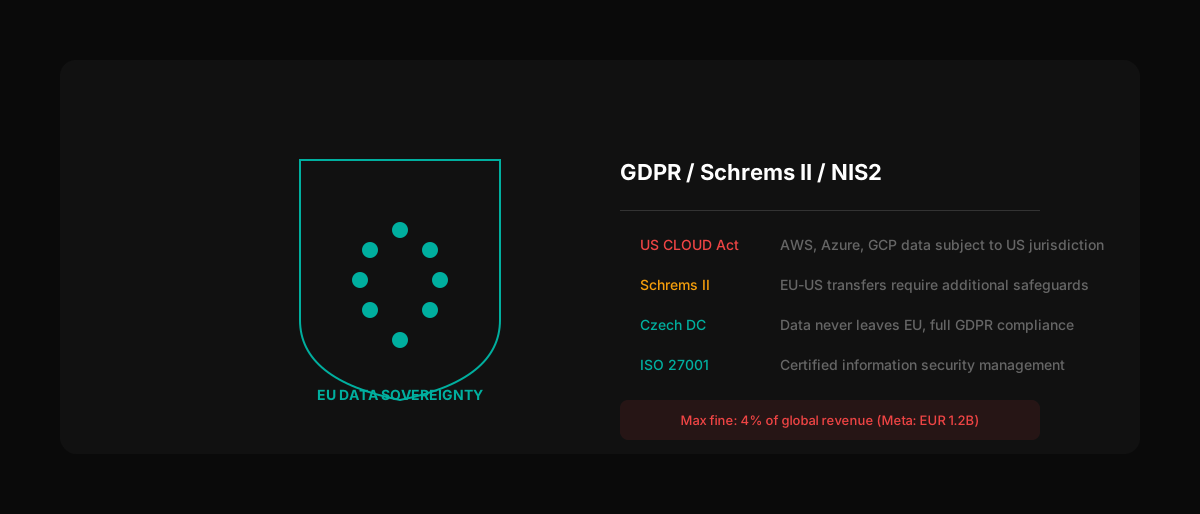
The European regulatory landscape has fundamentally changed where and how organizations can store data. GDPR, Schrems II, NIS2, and DORA collectively create a framework where choosing a non-EU cloud provider introduces legal risk, compliance complexity, and potential fines of up to 4% of global annual turnover. For organizations processing EU citizen data, a Czech cloud provider with its own datacenter in Prague offers the simplest path to full compliance.
What does GDPR actually require for cloud data storage?
GDPR (General Data Protection Regulation) imposes strict rules on where personal data of EU citizens can be processed and stored. Articles 44 through 49 specifically govern international data transfers — any movement of personal data outside the European Economic Area (EEA) requires either an adequacy decision from the European Commission, Standard Contractual Clauses (SCCs), or Binding Corporate Rules (BCRs).
Key GDPR provisions affecting cloud infrastructure:
- Article 44 — General principle: Any transfer of personal data to a third country may only take place if the controller and processor comply with the conditions in Chapter V.
- Article 45 — Adequacy decisions: The European Commission determines whether a third country ensures an adequate level of protection. As of 2026, the US relies on the EU-US Data Privacy Framework, which remains legally contested.
- Article 46 — Appropriate safeguards: In the absence of an adequacy decision, transfers require SCCs or other safeguards — plus a Transfer Impact Assessment (TIA).
- Article 48 — Transfers not authorized by Union law: Judgments of third-country courts requiring data transfer are not recognized unless based on an international agreement.
The practical implication: Every time your data leaves the EU on a US hyperscaler's infrastructure, you bear the burden of proving adequate protection. With a Czech cloud provider, this entire compliance layer disappears — your data never crosses an EU border.
What fines have been issued for GDPR cloud violations?
The enforcement record demonstrates regulators are serious:
- Meta (Ireland): EUR 1.2 billion fine (May 2023) for transferring EU user data to the US without adequate safeguards — the largest GDPR fine ever issued.
- Amazon (Luxembourg): EUR 746 million (July 2021) for data processing violations.
- Clearview AI (multiple DPAs): Combined fines exceeding EUR 60 million across France, Italy, Greece, and the UK for processing biometric data of EU citizens on US servers.
- Austrian DPA (2022): Ruled that Google Analytics use violated GDPR because data was transferred to the US without adequate protection.
These are not theoretical risks. EU Data Protection Authorities (DPAs) have issued over EUR 4.5 billion in GDPR fines since 2018, with international data transfer violations accounting for a growing share.
How does Schrems II affect your cloud provider choice?
The Court of Justice of the European Union (CJEU) invalidated the EU-US Privacy Shield in July 2020 (Case C-311/18, "Schrems II"). The court ruled that US surveillance laws — particularly Section 702 of FISA and Executive Order 12333 — are incompatible with EU fundamental rights because US intelligence agencies can access data of EU citizens without adequate judicial oversight.
The ruling's impact on cloud infrastructure is direct and measurable:
- Standard Contractual Clauses alone are insufficient if the destination country's laws undermine the protection they provide. For US transfers, organizations must conduct a supplementary Transfer Impact Assessment.
- The EU-US Data Privacy Framework (DPF), adopted in July 2023 as Privacy Shield's replacement, faces ongoing legal challenges. Privacy advocate Max Schrems filed a challenge in early 2024, and legal experts widely expect a "Schrems III" ruling that could invalidate the DPF.
- 72% of European enterprises surveyed by Eurostat in 2025 identified international data transfers as a top compliance concern.
What this means for your infrastructure: If you run workloads on AWS (us-east-1, us-west-2), Azure (US regions), or GCP (US regions), you are making an active bet that the current EU-US Data Privacy Framework will survive legal challenge. If it falls — as Privacy Shield did — you face an immediate compliance gap with no grace period.
Running on a Czech cloud with a Prague datacenter eliminates this risk entirely. No international transfers. No Transfer Impact Assessments. No dependency on geopolitical agreements.
Why is the US CLOUD Act a risk for European organizations?
The Clarifying Lawful Overseas Use of Data (CLOUD) Act, enacted in 2018, grants US law enforcement the authority to compel US-headquartered technology companies to provide data stored on their servers — regardless of where that data is physically located. This includes data stored in EU datacenters operated by AWS, Microsoft Azure, and Google Cloud Platform.
The conflict with GDPR is fundamental:
- GDPR Article 48 states that foreign court orders or administrative demands are not recognized as lawful grounds for data transfer unless based on an international agreement (such as a Mutual Legal Assistance Treaty).
- The CLOUD Act allows US authorities to bypass this requirement entirely by compelling the US-headquartered parent company to produce data.
- Your data in AWS eu-central-1 (Frankfurt) is not immune. Amazon Web Services, Inc. is a US entity. A US court order under the CLOUD Act can compel AWS to hand over data from any region, including EU regions.
This is not theoretical. The US Department of Justice has issued thousands of CLOUD Act requests since 2018, and US providers are legally prohibited from disclosing many of these requests to their customers.
How do EU providers differ from US hyperscalers on data sovereignty?
| Criterion | US Hyperscaler (AWS/Azure/GCP) | EU Provider | Czech Provider (Pro-zeta) |
|---|---|---|---|
| CLOUD Act exposure | Yes — US parent company | No | No |
| Data residency guarantee | Region-selectable, but no legal immunity | EU-only | Prague datacenter, data never leaves CZ |
| GDPR transfer risk | Requires TIA + SCCs for US entity | Minimal | None |
| Schrems II exposure | High — dependent on DPF validity | Low | None |
| DPA audit access | Complex, multi-jurisdictional | Straightforward | Direct — same jurisdiction |
| Infrastructure ownership | US corporation | Varies | Czech company (PRO-ZETA a.s., est. 1991) |
Pro-zeta operates its own datacenter in Prague. The parent company, PRO-ZETA a.s., is incorporated in the Czech Republic — an EU/EEA member state. There is no US parent entity, no CLOUD Act jurisdiction, and no international data transfer when you host with Pro-zeta. Your data is subject exclusively to Czech and EU law.
Learn more about our infrastructure at Tier5 cloud platform or about Pro-zeta.
What does the NIS2 Directive mean for your cloud infrastructure?
The NIS2 Directive (Directive (EU) 2022/2555) came into force across EU member states in October 2024. It significantly expands the scope of cybersecurity obligations compared to the original NIS Directive, now covering 18 sectors including energy, transport, banking, health, digital infrastructure, ICT service management, and public administration.
Key NIS2 requirements affecting cloud infrastructure decisions:
- Supply chain security (Article 21(2)(d)): Organizations must assess and manage cybersecurity risks in their supply chain, including cloud providers. Using a provider subject to foreign government access (CLOUD Act) introduces a supply chain risk that must be documented and mitigated.
- Incident reporting (Article 23): Significant incidents must be reported to the national CSIRT within 24 hours (early warning) and 72 hours (full notification). A provider in the same jurisdiction simplifies this process.
- Management body accountability (Article 20): Board members and senior management are personally liable for ensuring cybersecurity risk management. This is not delegable.
- Fines: Up to EUR 10 million or 2% of global annual turnover for essential entities.
NIS2 and cloud provider selection: The directive does not mandate EU-only hosting, but it creates strong incentives. Organizations must demonstrate they have assessed supply chain risks — and a US-headquartered cloud provider subject to the CLOUD Act is a documented supply chain risk that requires mitigation measures. A Czech provider eliminates this risk at the architecture level.
Pro-zeta holds ISO 27001 (information security management) and ISO 9001 (quality management) certifications, providing auditable evidence of security controls that NIS2 requires.
How does DORA affect financial sector cloud choices?
The Digital Operational Resilience Act (DORA, Regulation (EU) 2022/2554) applies to financial entities across the EU since January 2025. It imposes specific requirements on ICT third-party service providers, including cloud providers.
DORA requirements relevant to cloud infrastructure:
- ICT third-party risk management (Chapter V): Financial entities must maintain a register of all ICT third-party arrangements, conduct due diligence, and assess concentration risk.
- Concentration risk: Regulators can designate cloud providers as "critical ICT third-party service providers" subject to direct oversight by the European Supervisory Authorities (ESAs). AWS, Azure, and GCP are expected to be among the first designated.
- Subcontracting chains: Financial entities must have visibility into the full subcontracting chain of their cloud providers.
- Exit strategies (Article 28(8)): Contracts must include exit plans ensuring data portability and business continuity.
The practical impact: Financial institutions using a single US hyperscaler face concentration risk under DORA. Diversifying to a European or Czech provider is not just good practice — it is becoming a regulatory requirement. Pro-zeta's Tier5 OpenStack cloud provides an EU-sovereign alternative that helps financial entities manage DORA concentration risk.
What are the real costs of non-compliance?
Non-compliance costs extend far beyond regulatory fines:
- GDPR fines: Up to EUR 20 million or 4% of global annual turnover (whichever is higher).
- NIS2 fines: Up to EUR 10 million or 2% of global annual turnover for essential entities.
- DORA fines: Determined by national competent authorities; periodic penalty payments of up to 1% of average daily worldwide turnover per day for up to 6 months.
- Reputational damage: 87% of consumers say they would not do business with a company they perceive as having inadequate data protection (Cisco 2024 Data Privacy Benchmark Study).
- Business disruption: If a Schrems III ruling invalidates the DPF, organizations relying on US providers face immediate operational disruption while they scramble to find alternatives.
The cost of migrating to a compliant infrastructure proactively is a fraction of the cost of responding to a regulatory enforcement action or a sudden legal framework change.
How does Pro-zeta ensure data sovereignty?
Pro-zeta's approach to data sovereignty is architectural, not contractual:
- Own datacenter in Prague: Physical infrastructure owned and operated by PRO-ZETA a.s. No colocation with third-party providers subject to foreign jurisdiction.
- Czech legal entity: PRO-ZETA a.s., founded in 1991, incorporated in the Czech Republic. No US parent, no US subsidiary, no CLOUD Act exposure.
- ISO 27001 certified: Information security management system audited annually by an accredited certification body.
- ISO 9001 certified: Quality management system ensuring consistent service delivery.
- 8+ years OpenStack production experience: Operating enterprise-grade OpenStack clouds since 2016.
- HPE hardware: Enterprise-grade servers and networking — no commodity white-box infrastructure.
- No data leaves the EU: Contractual and technical guarantees that data remains in the Prague datacenter.
- Full audit trail: Customers can audit physical and logical access controls directly.
For organizations evaluating a VMware alternative that also satisfies data sovereignty requirements, Pro-zeta's Tier5 cloud provides both cost savings and compliance in a single platform.
What steps should you take to achieve cloud data sovereignty?
Moving to a sovereign cloud infrastructure is a structured process, not a one-time decision:
- Data classification: Identify which data assets contain personal data, sensitive data, or data subject to sector-specific regulation (financial, healthcare, public sector).
- Transfer Impact Assessment: For any data currently processed outside the EU, conduct a TIA documenting the legal basis, risks, and supplementary measures.
- Provider due diligence: Evaluate your cloud provider's corporate structure (is there a US parent?), datacenter locations, certifications, and contractual commitments.
- Architecture review: Ensure no data flows cross EU borders — including backups, logs, monitoring data, and DNS queries.
- Migration planning: Develop a phased migration plan prioritizing the most regulated data first.
- Contractual framework: Establish Data Processing Agreements (DPAs) that explicitly guarantee EU-only processing and exclude CLOUD Act exposure.
- Ongoing compliance: Implement continuous monitoring of regulatory changes (NIS2 implementation varies by member state, DORA evolving guidance from ESAs).
Pro-zeta's engineering team supports organizations through every step of this process. Contact us to discuss your data sovereignty requirements.
Frequently asked questions
Is storing data in an EU region of AWS/Azure/GCP sufficient for GDPR compliance?
No. While the data may physically reside in the EU, the US parent company remains subject to the CLOUD Act and US surveillance laws. GDPR compliance depends on the legal framework governing the data processor, not just the physical location of servers.
Does the EU-US Data Privacy Framework solve the Schrems II problem?
The DPF provides a current legal basis for EU-US data transfers, but it faces ongoing legal challenges and is widely expected to be tested before the CJEU again. Organizations should not treat the DPF as a permanent solution.
What is the difference between data residency and data sovereignty?
Data residency means data is stored in a specific geographic location. Data sovereignty means data is subject exclusively to the laws of the jurisdiction where it is stored — including protection from foreign government access. A Czech provider offers both.
Do I need to worry about NIS2 if I am not in a "critical" sector?
NIS2 expanded the scope significantly. It now covers "important entities" in sectors like manufacturing, food production, waste management, postal services, and digital providers. If your organization has 50+ employees or EUR 10M+ turnover in a covered sector, NIS2 likely applies to you.
How long does migration to a sovereign Czech cloud take?
Typical migrations to Pro-zeta's Tier5 platform take 4-8 weeks depending on environment size. Small environments (under 50 VMs) can be migrated in as little as 2 weeks. Pro-zeta provides migration tooling and engineering support throughout the process.